
Context: From food security to rural prosperity: India’s next agricultural transformation must move beyond increasing production towards enabling farmers and rural enterprises to capture a larger share of the value generated through storage, processing, logistics, branding and marketing.
Key Issues
- Production-centric agricultural finance: India has developed strong institutions for agricultural production credit through bank nationalisation, regional rural banks, cooperatives and Kisan Credit Cards, but financing mechanisms for the entire agricultural value chain remain underdeveloped.
- Unequal financing needs across sectors: Dairy, poultry and fisheries generate regular cash flows through continuous procurement and marketing, whereas seasonal commodities require large amounts of working capital during harvest and financing for inventory storage throughout the year.
- Working-capital constraints: A company investing ₹500 crore in a modern processing facility may require another ₹700–800 crore to procure, store and carry seasonal inventory, making access to appropriately structured finance essential for commercial viability.
- Seasonality limits enterprise growth: The sugar sector demonstrates how inventory finance and warehouse-backed lending can help overcome seasonal constraints; differences in sectoral growth may therefore reflect financing structures as well as production potential.
- Large agricultural financing gap: During 2023–24, agriculture and allied sectors recorded GVA of ₹48.8 lakh crore, compared with institutional credit flow of ₹20 lakh crore; indicative estimates suggest an agricultural value-chain financing opportunity exceeding ₹14 lakh crore.
- Low food processing: Only around 10–12% of agricultural produce is processed in India, compared with an estimated 35–45% across East, South and Southeast Asia and over 60% in many developed economies, limiting value addition and rural employment opportunities.
- Fragmented financing ecosystem: Warehouse-receipt lending, receivables financing, food-processing finance and agricultural infrastructure lending already exist, but remain isolated initiatives rather than parts of a comprehensive value-chain financing architecture.
Way Forward
- Shift from production credit to value-chain finance: Financing should cover commercially viable activities from farm inputs and aggregation to storage, processing, transportation, exports and retail, enabling rural India to capture more post-harvest value.
- Expand warehouse-receipt financing: Agricultural produce stored in warehouses can support lending against warehouse receipts, helping enterprises finance inventory without depending entirely on conventional collateral.
- Strengthen receivables and product finance: Receivables financing can unlock funds tied up in unpaid invoices, while product finance can support the movement of commodities and working capital across the agricultural supply chain.
- Adopt cash-flow-based lending: Credit decisions should increasingly reflect commodity-specific value chains, expected cash flows and inventory cycles, rather than relying exclusively on conventional collateral.
- Develop risk mitigation and credit enhancement: A diversified portfolio of financial instruments should include risk-mitigation solutions and credit-enhancement mechanisms to improve access to finance across different stages of the value chain.
- Mobilise private investment: A comprehensive financing architecture can channel capital towards farmers, input suppliers, aggregators, warehouse operators, processors, logistics providers, exporters and retailers, strengthening the rural enterprise ecosystem.
- Link finance with rural industrialisation: Improved financing for processing and allied activities can generate rural employment, improve farmers’ incomes and accelerate the development of rural industries, contributing to the vision of Viksit Bharat 2047.
India’s next agricultural transformation requires financing not merely the production of crops, but the entire value chain through which agricultural output becomes income, employment and rural prosperity.
“India’s next agricultural transformation must shift from financing agricultural production to financing the entire agricultural value chain.” Discuss the need for this transition and examine the role of innovative financial instruments in promoting rural prosperity. (10 marks)
Parvesh Sahib Singh’s slap is about more than abuse of power (GS-IV: Ethics | Emotional Intelligence | Accountability | Ethical Leadership | Civic Values)
Context: An elected representative’s alleged assault on a protesting citizen highlights the ethical responsibilities of public officials and the wider challenge of preventing anger from becoming a justification for violence.
Ethical Issues Involved
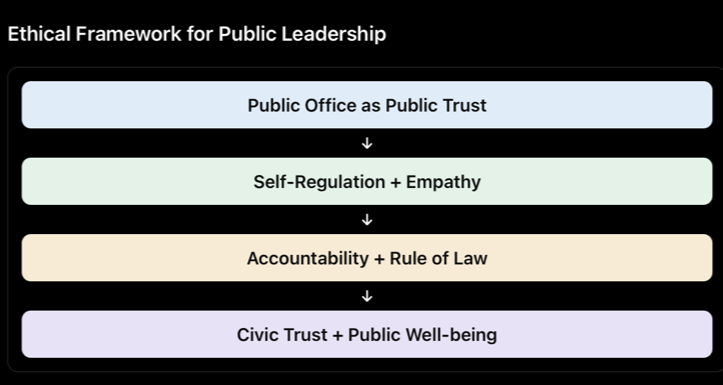
- Abuse of authority: Public office is a position of public trust, not a licence to intimidate citizens; elected representatives must exercise authority with dignity, restraint and respect for the rule of law.
- Accountability of public officials: Violations by those entrusted with power require timely investigation and due process, reinforcing the principle that no individual is above the law.
- Emotional intelligence and self-regulation: Frustration over poor public services may be understandable, but retaliatory violence aggravates conflict; ethical conduct requires managing anger rather than allowing it to dictate action.
- Confusion between courage and aggression: Treating uncontrolled anger as courage and restraint as weakness undermines empathy, tolerance and peaceful conflict resolution.
- Declining civic ethos: Everyday social stability depends on elementary principles of civil behaviour, mutual respect and the ability to disagree without resorting to intimidation or violence.
- Ethics in leadership: The conduct of public representatives shapes citizens’ perceptions of acceptable behaviour; abuse of power can normalise aggression and weaken public trust in institutions.
- Institutional integrity: Ethical governance requires institutions to uphold the letter and spirit of the law, including when violations involve politically influential individuals.
Ethical Responsibilities of Public Administrators and Leaders
- Constitutional morality: Public administrators must place constitutional values, legality and citizens’ dignity above personal loyalties, political pressure or partisan considerations.
- Integrity and impartiality: Allegations against public officials should be addressed through fair, transparent and time-bound procedures, irrespective of the individual’s political affiliation or position.
- Emotional intelligence: Administrators and leaders must demonstrate self-awareness, empathy and emotional regulation, particularly during public protests, confrontations
- Empathy and responsiveness: Public anger over unsafe roads and inadequate services should be treated as a signal of governance failure, requiring officials to listen to grievances and address their underlying causes.
- Non-violent conflict resolution: Administrators should facilitate dialogue, peaceful protest and institutional grievance redressal instead of allowing disagreements to escalate into confrontation.
Way Forward
- Build a culture of accountability: Citizens of all ideological affiliations should actively demand institutional accountability instead of allowing political loyalties to excuse misconduct.
- Promote civic education: Ethical values such as restraint, tolerance, empathy, cooperation and respect for opposing viewpoints should be cultivated among young people and across generations.
- Encourage participatory democracy: Youth-led initiatives should prioritise participation, cooperation and constructive institution-building over retaliation and a command-oriented culture.
- Practise non-violence: Jayaprakash Narayan’s slogan, “Hamla chahe jaisa hoga, haath hamara nahin uthega” — whatever the nature of the attack, we will not raise our hands in retaliation — captures the ethical strength of non-violent resistance.

Ethical leadership is demonstrated not by the ability to exercise power or express anger, but by the restraint to respect human dignity, the integrity to accept accountability and the courage to uphold the rule of law.
“The true test of ethical leadership lies in exercising power with restraint and ensuring accountability, especially when public anger and political pressure are high.” Discuss with reference to the ethical responsibilities of public administrators and elected representatives. (10 marks)
Done with this article? Mark it so you can track your revision on the blog page.