
Surya: India’s First Indigenous Fleet Support Ship
Context: Defence Minister Rajnath Singh launched Surya, the Indian Navy’s first indigenous Fleet Support Ship (FSS-1), at Hindustan Shipyard Limited (HSL), Visakhapatnam.
Key Points
- Project cost: ₹19,000 crore contract between the Ministry of Defence and HSL for construction of five fleet support ships.
- Indigenous content: 82%, supporting the Aatmanirbhar Bharat initiative.
- Purpose: To replenish naval vessels at sea, enabling prolonged operations far from home ports.
- Fuel capacity:
- 20,000 tonnes of high-speed diesel.
- 2,500 tonnes of aviation turbine fuel.
- Other supplies: Fresh water, ammunition, spare parts and other dry cargo.
- At-sea replenishment: Can transfer fuel, stores and personnel to multiple warships, supporting sustained naval deployments.
- Strategic significance: Enhances naval logistical support, operational endurance and

Dig deeper: What is Arihant class and Kalavari Class in Indian Navy Fleet?
Leprosy
Context: India continues to report new leprosy cases despite a decline in prevalence, childhood cases and Grade-2 disability rates over the past decade.
Key Points
- In 2005, India achieved the World Health Organization’s threshold for elimination of leprosy as a public health problem.
- However, elimination at the national level did not mean that transmission had stopped. Only 148 districts had achieved “interruption of transmission” in 2025–26, pending field verification.
What does “elimination” mean?
- Elimination as a public health problem: Reducing prevalence below the World Health Organization’s threshold of 1 case per 10,000 population.
- It does not mean that leprosy has disappeared or that no new cases are occurring.
- Interruption of transmission is a more ambitious goal: stopping new infections from occurring in a defined area.
3. National Strategic Plan (NSP), 2023–2027
- Objective: Achieve interruption of leprosy transmission at the district level by 2027.
- Early detection: Door-to-door screening, contact tracing and focused campaigns in high-burden areas.
- Prevention: Single-dose rifampicin as post-exposure prophylaxis for eligible contacts.
- Digital surveillance: Use of the Nikusth 2.0 portal for case reporting and monitoring.
- Challenges: Childhood infections, delayed diagnosis, stigma, misdiagnosis and uneven disease burden across States.
- Priority States: Chhattisgarh, Jharkhand, Odisha and Maharashtra are identified in the provided report as disproportionately affected.
4. What is Leprosy?
- Also called: Hansen’s disease.
- Cause: Infection by the bacteria Mycobacterium leprae.
- Type: Chronic infectious disease and a neglected tropical disease (NTD).
- Organs affected: Mainly the skin and peripheral nerves; it can also affect the eyes and nasal lining.
- Transmission: Primarily through respiratory droplets during prolonged, close contact with an untreated infected person.
- Symptoms: Skin patches with loss of sensation, numbness, muscle weakness and nerve damage.
- Treatment: Multidrug therapy (MDT); early diagnosis and treatment help prevent disability.
- Stigma: Fear and discrimination often delay diagnosis and treatment.
WHO criteria: Elimination vs Eradication
Term | Meaning / criterion |
Elimination as a public health problem | Prevalence reduced below 1 case per 10,000 population. India achieved this milestone in 2005. |
Interruption of transmission | No new locally acquired childhood cases for at least 5 consecutive years in the area being assessed. |
Elimination of leprosy disease | No new locally acquired cases among all age groups for 3 consecutive years, following interruption of transmission. |
Eradication | Permanent reduction to zero worldwide transmission; the disease no longer occurs naturally anywhere. Leprosy has not been eradicated. |
Read About Baba amte and his work on leprosy
SME Growth Fund
Context: The Union Cabinet approved ₹10,000 crore as announced in Budget 2026 in central government funding to establish the Small and Medium Enterprises (SME) Growth Fund.
Key Points
Small and Medium Enterprises Growth Fund (SME Growth Fund)
Why in News?
- The Union Cabinet approved a ₹10,000 crore commitment to establish the SME Growth Fund under the Union Budget 2026–27 announcements.
- The Fund will provide equity capital to high-potential SMEs to expand operations, adopt advanced technologies and improve competitiveness.
Key Points
1. Classification of SMEs
- Small enterprise: Investment up to ₹25 crore and annual turnover up to ₹100 crore.
- Medium enterprise: Investment up to ₹125 crore and annual turnover up to ₹500 crore.
- These classification criteria are effective from April 2025 and are based on investment in plant and machinery or equipment and annual turnover.
Contribution of MSMEs to the Indian Economy
- According to the Economic Survey 2025–26, MSMEs contribute:
- 31.1% of GDP
- 35.4% of manufacturing output
- 48.58% of exports
- As of October 6, 2026, approximately 9.78 crore MSMEs were registered under Udyam and the Udyam Assist Platform (UAP).
- These registrations reported approximately 43.28 crore employment opportunities.
- Female-owned enterprises account for 37.6% of total registrations.
- Sector-wise registrations:
- Trading: 4.08 crore
- Services: 3.77 crore
- Manufacturing: 1.93 crore
SME Growth Fund: Structure and Objectives
- The Fund will operate as an Alternative Investment Fund (AIF) and provide direct equity investment.
- An AIF is a privately pooled investment fund that raises money from investors and invests it according to a defined policy.
- It aims to address the limited availability of growth equity capital for established SMEs.
- It will support enterprises with demonstrated business viability and scalability across manufacturing, services, technology, innovation-driven sectors and strategic value chains.
Priority Areas
- A major share of the Fund will be directed towards manufacturing-focused SMEs to:
- Expand manufacturing capacity.
- Adopt advanced technologies.
- Improve productivity.
- Strengthen export competitiveness.
- SMEs operating in industrial clusters in Tier-II and Tier-III cities will also be considered.
- Long-term capital can support business expansion, acquisitions, innovation, strategic investments and integration into global value chains.
Other Government Schemes Supporting MSMEs
- Credit and finance: Credit Guarantee Fund Trust for Micro and Small Enterprises (CGTMSE).
- Employment generation: Prime Minister’s Employment Generation Programme (PMEGP).
- Artisans and craftspeople: PM Vishwakarma.
- Training and entrepreneurship: Entrepreneurship and Skill Development Programme (ESDP) and ASPIRE.
- Technology and productivity: Raising and Accelerating MSME Performance (RAMP), Zero Defect Zero Effect (ZED) Scheme, Tool Rooms and Technology Centres.
- Public procurement: MSME SAMBANDH and the National SC-ST Hub.
Dig deeper: Read about What are Central sector schemes and Centrally sponsored schemes.
Joint India–Argentina Army Mountaineering Expedition
Context: Chief of the Army Staff (COAS) General Dhiraj Seth flagged in the joint India–Argentina Army mountaineering expedition after its successful ascent of Mt Abi Gamin (7,355 m) on 17 September and Mt Kamet (7,756 m) on 21 September 2026.
Key Points
Mountains Mentioned
Mountain | Height | Location / Mountain Range | Significance |
Mt Kamet | 7,756 m | Chamoli district, Uttarakhand; Garhwal Himalayas | Third-highest peak in India, after Kanchenjunga and Nanda Devi |
Mt Abi Gamin | 7,355 m | Uttarakhand; Garhwal Himalayas, near the India–Tibet border | One of the two peaks successfully climbed during the 2026 expedition |
Mt Aconcagua | 6,962 m | Mendoza, Argentina; Andes Mountains | Site of the first joint India–Argentina mountaineering expedition mentioned, in January 2025 |
Mt Kun | 7,077 m | Suru Valley, Ladakh; Himalayan range | Site of the second joint expedition, in August 2025 |
Dig deeper: Which is the Highest peak in world (Top 3) and deepest trenches (Top3) ?
Neutrinos and IceCube Neutrino Observatory
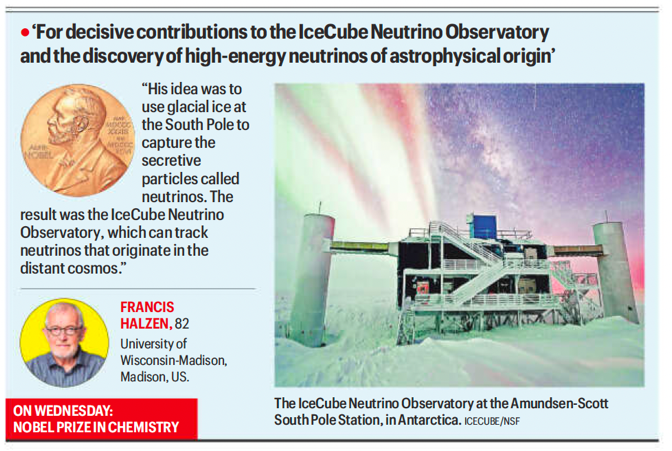
Context: Francis Halzen was awarded the 2026 Nobel Prize in Physics for his work on the IceCube Neutrino Observatory in Antarctica.
Key Points
What are Neutrinos?
- Neutrinos are subatomic particles produced mainly in nuclear reactions in stars.
- They are among the most abundant particles in the universe, second only to photons.
- They are called “ghost particles” because they rarely interact with matter and are extremely difficult to detect.
- Neutrinos were proposed in the 1930s and first detected in the 1950s.
Properties of Neutrinos
- Very small: They are subatomic particles.
- Electrically neutral: They do not respond to electromagnetic fields like charged particles.
- Extremely weak interaction with matter: They can pass through dense matter, including the Earth, with little chance of interacting.
- Highly abundant: Nearly 65 billion neutrinos pass through human fingernails every second.
- Travel through dense cosmic regions: Unlike electromagnetic radiation, neutrinos can escape regions where light may be absorbed or scattered.
- Difficult to detect: Only a tiny fraction interact with matter, requiring very large detectors.
3. What is IceCube?
- The IceCube Neutrino Observatory is a neutrino detector located deep beneath the Antarctic ice near the South Pole.
- It uses one cubic kilometre of ice and more than 5,000 light sensors installed on long cables.
- The South Pole provides an isolated environment, with darkness at great depths and little interference from other signals.

How does IceCube work?
- A neutrino occasionally collides with an atomic nucleus in the ice.
- The collision produces a charged particle.
- If the charged particle travels faster than light travels through ice, it produces a faint glow.
- IceCube’s light sensors detect this glow.
- Scientists analyse the light to reconstruct the neutrino’s energy and direction.
Why is IceCube important?
- It detected high-energy neutrinos arriving from distant, extra-galactic sources.
- In 2013, it presented the first evidence of very high-energy neutrinos.
- Neutrinos can reveal processes occurring inside or beyond dense cosmic regions that electromagnetic radiation may not escape.
- Their detection adds a new way to study cosmic events.
India’s Neutrino Observatory
- The India-based Neutrino Observatory (INO) is a delayed project intended to build a neutrino detector in India.
- It was initially proposed for Kerala and later for Tamil Nadu.
- The project faced opposition from local and political groups over land acquisition and environmental concerns.
- A new location had not been finalised.
Dig deeper: What are Quarks ?
Done with this article? Mark it so you can track your revision on the blog page.