
Ramappa Temple
Context: The Rudreshwara Temple, popularly known as Ramappa Temple, is in Mulugu district, Telangana and was inscribed on the UNESCO World Heritage List in 2021.
It is currently in the news because heritage activists are opposing the proposed PVNR opencast coal mine at Venkatapur, arguing that mining activity could affect the temple.

Key Points
- Built by: Kakatiya ruler Ganapati Deva, with construction undertaken by his general Recherla Rudra.
- Period: 13th century; 1213 AD.
- Presiding deity: Ramalingeswara Swamy.
- Architectural feature: Built on a 6-foot-high star-shaped platform, with intricate carvings on walls, pillars and ceilings.
- Foundation: Uses the distinctive sandbox technique, involving a mixture of sand, lime, jaggery and karakkaya(black myrobalan) beneath the foundation.
- Purpose of sandbox technique: The sand layer acts as a cushion, helping absorb and reduce vibrations, including those caused by earthquakes.
- Materials: Granite flooring, basalt pillars and red sandstone in the lower portion; the gopuram uses lightweight bricks.
- Name: The temple is popularly called Ramappa Temple after the sculptor, who worked on it for about 40 years.
- UNESCO: It is India’s 39th World Heritage Site.
Dig deeper: Which are the last 5 UNESCO sites in India inscribed recently?
Supercomputers in India
Context: India’s supercomputing journey began with PARAM 8000 in 1991 and has evolved into a national High-Performance Computing (HPC) ecosystem under the National Supercomputing Mission (NSM). As of September 2026, India has 40 supercomputers with a combined capacity of 68 PF.
Key Points
What is a Supercomputer?
- A supercomputer is a high-performance computing system designed to perform extremely complex calculations at very high speeds.
- It combines a large number of processors or computing nodes that work simultaneously through parallel processing.
- It is used for processing massive datasets and running complex simulations in areas such as weather forecasting, climate modelling, space research, healthcare, Artificial Intelligence and engineering.
- Computing power is measured in FLOPS (Floating Point Operations Per Second):
- 1 TFLOPS = 1 trillion calculations per second.
- 1 PFLOPS = 1 quadrillion calculations per second.
- 1 EFLOPS = 1 quintillion calculations per second.
National Supercomputing Mission (NSM)
- Launched: April 2015.
- Initial outlay: About ₹4,500 crore.
- Nodal ministries: Department of Science and Technology (DST) and Ministry of Electronics and Information Technology (MeitY).
- Implemented by: Centre for Development of Advanced Computing (C-DAC), Pune and Indian Institute of Science (IISc), Bengaluru.
- Main objective: Build self-reliance in supercomputing and establish a globally competitive HPC ecosystem in India.
- Build approach: Three parallel components — assembly, manufacturing, and design/manufacturing support.
- Target: 50 supercomputers with cumulative computing capacity exceeding 123 PF across academic and research institutions.
- Applications: Weather and climate modelling, genomics and drug discovery, flood prediction, forest-fire modelling, seismic imaging, computational chemistry and materials science.
Evolution of PARAM Series
Supercomputer | Year / Capacity | Significance |
PARAM 8000 | 1991; 1 GFLOPS | First indigenous Indian supercomputer; developed by C-DAC. |
PARAM Yuva | 54 TFLOPS | Expanded India's capacity for computationally intensive scientific applications such as weather forecasting and computational fluid dynamics. |
PARAM Rudra | 3 PetaFLOPS | Built using indigenously designed Rudra servers and indigenous system software; supports astronomy, materials science, atomic physics and earth sciences. |
Dig deeper: Which is the fastest computer today in world?
Sal Heartwood Borer
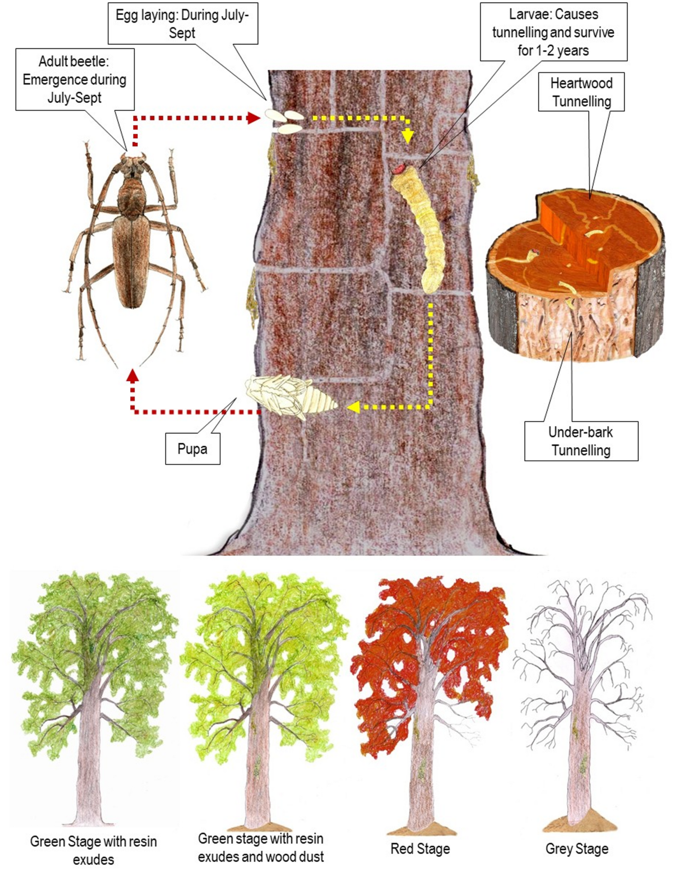
Context: Madhya Pradesh has approved the felling of around 1.47 lakh infected sal trees in Dindori following a major outbreak of the sal heartwood borer. The exercise combines trapping adult beetles and removing infected trees to prevent the infestation from spreading.
Key Points
Sal Heartwood Borer
- Scientific name: Hoplocerambyx spinicornis.
- Type: A longhorn beetle and destructive pest of sal trees.
- Host: Primarily sal (Shorea robusta).
- First recorded as a threat: 1897.
- Target trees: It generally attacks weaker trees but can kill sal trees of different ages once their girth exceeds 20 cm.
- Major impact: Mortality is particularly high among mature trees with a 121–150 cm girth, which form an important part of the forest canopy.
- Epidemic history: More than 21 sal-borer epidemics have been recorded in India.
- Previous major outbreak: Madhya Pradesh and Chhattisgarh experienced a major outbreak during 1997–2000, affecting about 3 lakh hectares of sal forest.
- Control measures:
- Trap trees: Selected trees are felled and debarked to attract adult beetles, which are then collected manually.
- Sanitation felling: Already infected standing trees are removed to prevent further spread.
- Current collection: Over 19.25 lakh beetles have been collected in Dindori this season; villagers receive ₹2 per beetle.
- Possible factor behind current outbreak: Unusually high rainfall in the Dindori–Mandla region in the previous year may have created

Dig deeper: What are xylem, phloem, heartwood, cambium, etc?
High-Decibel Birds: Bellbird and Red-Legged Seriema
Context: A study of Brazilian birds found that the bare-throated bellbird and red-legged seriema are among the loudest birds recorded, with their calls reaching 121–122 decibels (dB). Their calls can be louder than several familiar loud sounds, including elephants, jackhammers and chainsaws.
Key Points
1. Bare-throated Bellbird
- Scientific name: Procnias nudicollis
- Distribution: Brazil, particularly the Atlantic Forest.
- Family: Cotingidae.
- Size: About the size of a dove.
- Distinctive feature: Male has a bare throat and produces a powerful metallic call.
- Sound: Recorded at around 121–122 dB, making it exceptionally loud for a bird.
- Function: The male uses its loud call to attract females.
- Trivia: Its call can be louder than an elephant’s trumpet, jackhammer or chainsaw.
2. Red-Legged Seriema
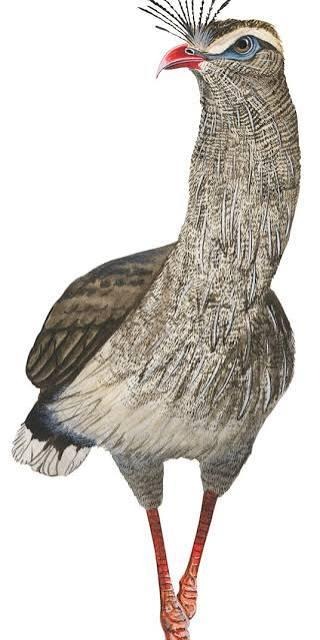
- Scientific name: Cariama cristata
- Distribution: Brazil, especially its savanna and open-landscape regions.
- Family: Cariamidae.
- Distinctive features: Long legs, long neck and reddish legs.
- Sound: Its call was also recorded at around 121–122 dB.
- Why so loud? Researchers found that the length of its neck and shape of its beak help amplify its call.
- Trivia: The red-legged seriema is about as tall as the country’s savanna, according to the source’s comparison, and is known for its distinctive, loud,

Dig deeper: Which is the fastest flying bird?
News in Short
Ig Nobel Prizes 2026
- Ig Nobel Prizes are a light-hearted parody of the Nobel Prizes, recognising scientific research that is unusual, amusing or seemingly absurd while still involving serious investigation.
- Instituted: 1991 by Marc Abrahams, editor of The Journal of Irreproducible Results.
- Unlike the Nobel Prizes, Ig Nobel categories can change from year to year.
Ethiopia’s govt. retakes Mekelle
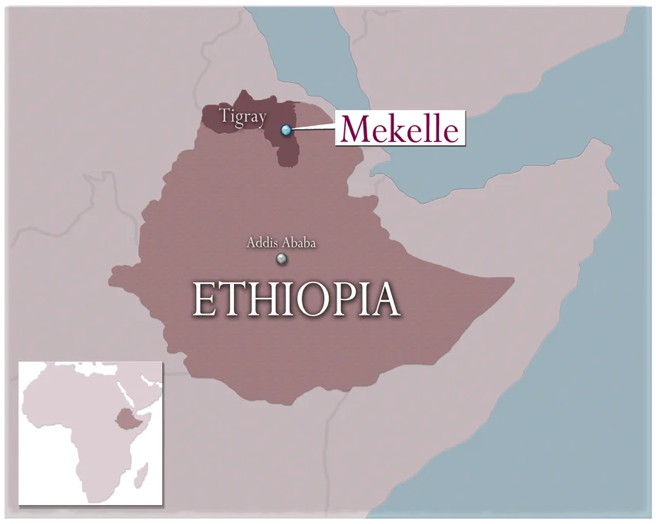
- The TPLF also pulled out of the Mekelle airport, which they had seized last month.

Done with this article? Mark it so you can track your revision on the blog page.