
Manhattan Project
Context: The Manhattan Project was the secret U.S.-led programme during World War II to develop the first nuclear weapons. It was driven partly by Allied fears that Nazi Germany might also develop an atomic bomb, particularly through the work of physicists such as Werner Heisenberg.
Key Points
- Started: 1942, during World War II.
- Led by: The United States, with cooperation from the United Kingdom and Canada.
- Scientific leadership: J. Robert Oppenheimer headed the Los Alamos laboratory, where the bomb was designed.
- Military leadership: General Leslie Groves directed the overall project.
- Major objective: Develop an atomic bomb before Nazi Germany.
- Major facilities: Oak Ridge, Tennessee — uranium enrichment; Hanford, Washington — plutonium production; Los Alamos, New Mexico — bomb design and assembly.
- First nuclear test: Trinity test, 16 July 1945, in New Mexico.
- Bombs produced: The project produced the uranium bomb Little Boy and plutonium bomb Fat Man.
- Use in war: The bombs were used against Hiroshima (6 August 1945) and Nagasaki (9 August 1945).
- Scale: At its peak, the programme involved about 1.3 lakh workers and an investment of approximately $2.2 billion, according to the source.
- Significance: It demonstrated the feasibility of nuclear weapons and marked the beginning of the nuclear age.
Dig deeper: What was the name of nuclear tests done by India?
DRT3b
Context: A new bacterial defence system called DRT3 has been identified in recent studies.
Its component DRT3b can help produce a specific DNA sequence without using a DNA/RNA template, making it unusual in molecular biology. Pasted markdown
Key Points
- DRT3b is a protein/enzyme found in bacteria.
- It is part of the bacterial defence system against bacteriophages (viruses that infect bacteria).
- Its unusual feature is that it can direct the formation of a specific DNA sequence by itself.
- Normally, DNA sequence formation depends on information from another nucleic acid (DNA or RNA).
- Therefore, DRT3b appears to show information flowing from protein → DNA, which is unusual.
- This has raised questions about the Central Dogma of Molecular Biology.
- However, it does not overturn the Central Dogma; it only pushes the boundaries of the principle.
- Core takeaway: It is an unprecedented mechanism showing that proteins can influence the formation of a specific DNA sequence without a nucleic-acid template.
Dig deeper: What is Translation and Transcription?
Brahmaputra–Bangladesh Inland Waterway Link
Context: For the first time since Independence, cargo from Dibrugarh in Upper Assam has been sent to a foreign port by river.
Key Points
- Cargo: 540 metric tonnes of methanol produced by Assam Petro-Chemicals Ltd. (APCL), Namrup.
- Origin: Bogibeel Terminal, Dibrugarh, Assam.
- Destination: Pangaon Port, Dhaka, Bangladesh.
- Route: Around 768 km on National Waterway-2 (Brahmaputra) to the India-Bangladesh border, followed by the Indo-Bangladesh Protocol Route (IBPR).
- Total distance: Around 1,300 km from Bogibeel to Narayanganj, Dhaka.
- Vessel: DLB Patkai, pushed by tug Kushal Konwar.
- Significance: Tests whether the Brahmaputra can become a commercially viable freight corridor connecting the Northeast to overseas markets.
National Waterway-2
- River: Brahmaputra.
- Declared as NW-2: In 1988.
- Stretch: Sadiya to Dhubri — 891 km.
- Importance: Provides an inland-waterway connection across Assam and towards the India-Bangladesh riverine network.
- Regular cargo service: Began in December 2017, when cement was transported from Pandu to Dhubri.
Historical Link
- Dibrugarh was historically an important river port for tea, timber and passenger movement.
- Steamers reached Dibrugarh from Calcutta by 1856, while daily steamer services operated by 1913.
- River trade declined after Partition in 1947, the 1950 earthquake, and the shift of tea transportation towards railways.
- Dibrugarh Ghat closed in 1956.
- The India-Bangladesh Protocol on Inland Water Transit and Trade was signed in 1972, providing a framework for movement through the two countries' waterways.
Dig deeper:
Nobel Prize in Medicine 2026: Optogenetics
Context: Karl Deisseroth, Peter Hegemann and Georg Nagel won the 2026 Nobel Prize in Physiology or Medicinefor discoveries that laid the foundation of optogenetics.
Their work enabled scientists to use light-sensitive proteins called opsins to control the activity of specific cells.
Key Points
What is optogenetics?
- Optogenetics is a technique that uses light to manipulate the activity of specific neurons or other cells.
- Light-sensitive proteins are expressed in targeted cells; when light is applied, these proteins act as switches that can activate or inhibit cellular activity.
- In neuroscience, this allows scientists to switch specific groups of neurons on or off with high precision.
Why it is important for brain research
- Optogenetics allows researchers to activate or inhibit specific neural circuits and observe the resulting behaviour.
- It has been used to investigate neural circuits involved in pain, social behaviour, thirst, food consumption, reward, attention and memory.
Medical applications
- Optogenetics remains largely a laboratory research technique, particularly for studying neural circuits in animals.
- Clinical trials are exploring its use for restoring vision in people with retinitis pigmentosa, a disease that destroys the eye’s rods and cones.
- In one approach, special glasses provide light stimulation to help patients detect and grasp objects.
- Researchers are also exploring optogenetics for improving cochlear implants, which currently stimulate the auditory nerve electrically.
Dig deeper: How many Nobel Prizes are given by Nobel committee?
News in Short
India’s thermal power sector
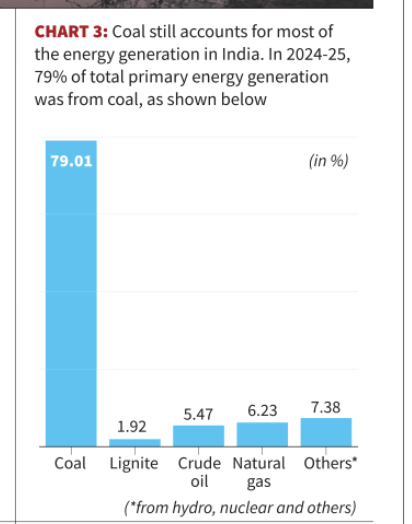
- It is facing pressure from rising electricity demand and low coal inventories.
- As of September 30, 84 of 191 thermal power plants (44%) had critically low coal stocks, while coal accounted for 79% of total electricity generation in

Asian Games 2026 – The Hindu QUIZ
Question | Answer |
1. India’s 85-medal tally included 21 gold medals. With which country did India tie for the gold-medal count? | Uzbekistan — both India and Uzbekistan won 21 gold medals. |
2. Who was the only Indian to win all three types of medals, and in which events? | Vithya Ramraj — Gold: Women’s 4×400 m relay; Silver:Mixed 4×400 m relay; Bronze: Women’s 400 m hurdles. |
3. At 15 years, 6 months, and 6 days, who became India’s youngest-ever gold medal winner? | Vaibhav Sooryavanshi — won gold as part of India’s men’s cricket team. |
4. Which sport gave India the maximum gold medals, with five? | Archery — India won 5 gold medals. |
5. Apart from Neeru Dhanda, who else returned with two gold medals? | Kumkum Mohod — won gold in women’s recurve individual and women’s recurve team events. |
Note: Kumkum Mohod actually won three medals overall — two gold and one silver. Prithika Pradeep also won two gold medals, so if the question asks for all athletes besides Neeru with two golds, Kumkum Mohod and Prithika Pradeep should be included.
India–Japan Joint Crediting Mechanism (JCM)
- India and Japan launched the Operational Manual for the India–Japan Joint Crediting Mechanism (JCM) on 30 September 2026.
- It moves the bilateral JCM from the preparatory stage to actual implementation under Article 6.2 of the Paris Agreement.
- Purpose: Promote deployment of advanced low-carbon technologies in India.
- Paris Agreement: Operates under Article 6.2, which provides for cooperation between countries through internationally transferred mitigation outcomes.
Exercise MOUNTAIN GUARDIAN 2026
- Countries: India and United Arab Emirates (UAE)
- Type: Joint military exercise between the Indian Army and UAE Army.
- Location: Foreign Training Node, Chaubatia, Uttarakhand.
- Focus: Mountain Warfare.
- Indian contingent: Troops from a Bhairav Battalion.
- UAE contingent: Troops from a Mountain Infantry Battalion.
- Women personnel: Women officers and combatants from both armies are participating.
Done with this article? Mark it so you can track your revision on the blog page.